Most clinical software records what happened. SaroviX is designed to help the clinician understand what is happening and what should happen next.
The workspace brings together voice, imaging, labs, documents, genomics, notes, tasks, orders, and clinical reasoning. The doctor should not need to leave the patient context to inspect a scan, draft a note, generate a report, or ask for missing information.
The agent should operate inside the clinical surface
A useful medical agent cannot be a chat box floating beside medicine. It has to understand the scan on screen, the patient timeline, the prior note, the missing lab, the differential, and the physician's spoken intent.
That is why SaroviX is built as a workspace first. Voice, imaging, analysis, and documentation are not separate products. They are parts of the same clinical operating system.
When the physician asks a question, the system should know what is being asked about. If the current view is an abdominal CT, the agent should understand the slice, the segmentation, the prior report, and the patient history. If the current view is a molecular docking run, it should understand receptor, ligand, ranked poses, affinity readouts, and why the run matters for the patient. If the current task is a follow-up note, it should understand the plan and the missing data.
The product is the work surface
SaroviX is not a wrapper around a model. It is a clinical operating surface: patient management, imaging, voice, documents, scheduling, coding, orders, report generation, bioinformatics outputs, protein lab context, and digital-twin views. The agent becomes more valuable because it is grounded inside that surface.
WHO guidance on AI for health emphasizes governance, transparency, safety, and accountability. For Sarovi, that means the interface must make reasoning inspectable, keep the clinician in control, show uncertainty, and preserve a clear audit trail. Medical AI should increase leverage without turning medicine into a black box.
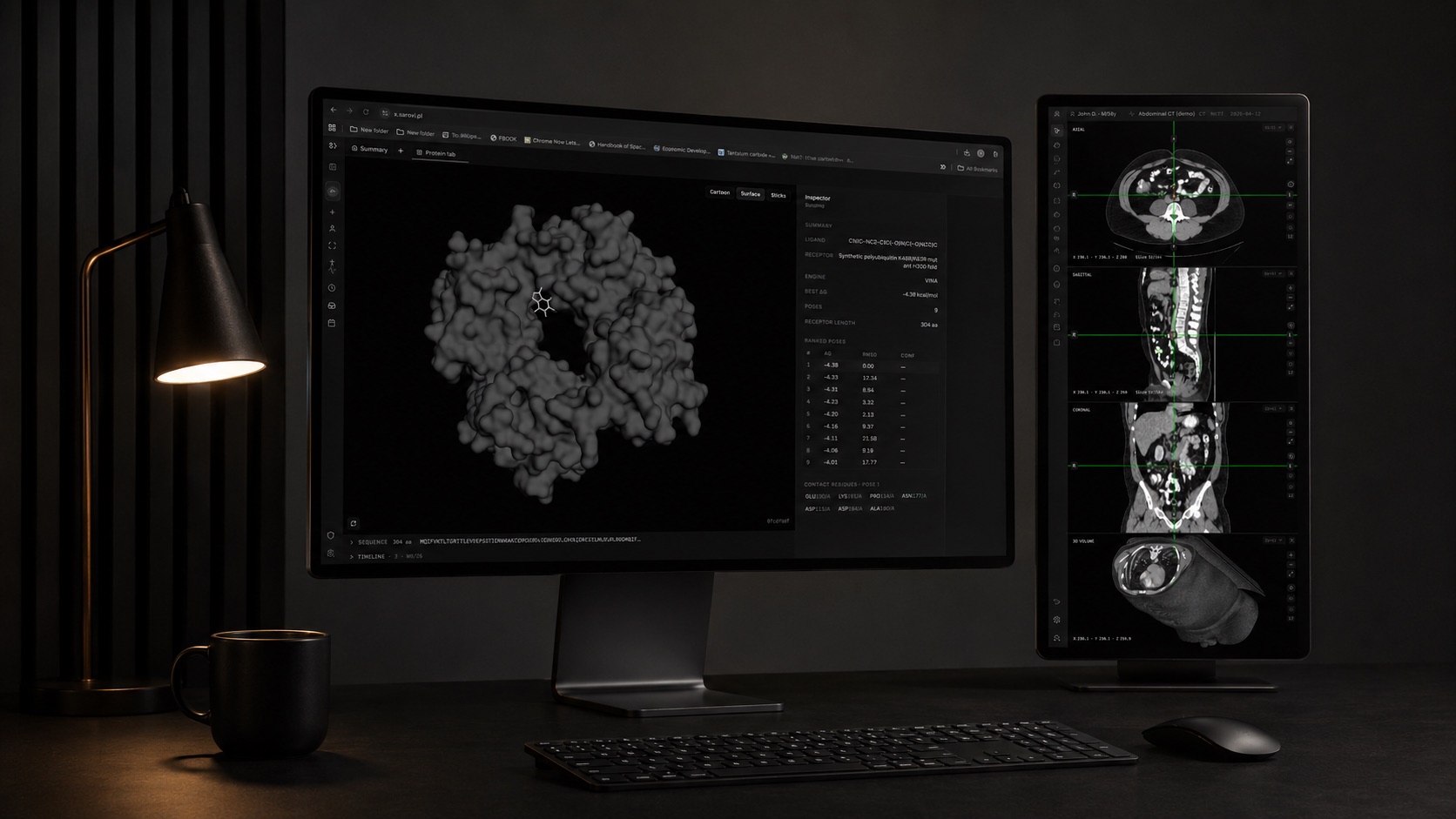
From voice to scan, from scan to note.
This is not a separate chatbot. The physician talks to the workspace, the agent sees the active view, and the output can become a note, missing-data list, report, or team task.
- Voice: clinical intent recognition and documentation drafting without leaving the patient.
- Imaging: CT/MRI/NIfTI questions grounded in the active series and prior studies.
- Audit: every generated fragment should point back to source context and uncertainty.
The point is not to make a clinician talk to software. The point is to let the clinical workspace listen, prepare, reason, and reduce the number of times a doctor has to leave the patient to operate the system.
References
- WHO, Ethics and governance of artificial intelligence for health, principles for safe and accountable AI in healthcare.
- Sinsky et al., Annals of Internal Medicine, physician time allocation across clinical and EHR work.
- European Commission, European Health Data Space, policy context for health data interoperability and reuse.