Organ systems, diagnoses, medications, imaging findings, molecular signals, patient goals, and care plan.
Continuum
Digital twin infrastructure without the cliché.
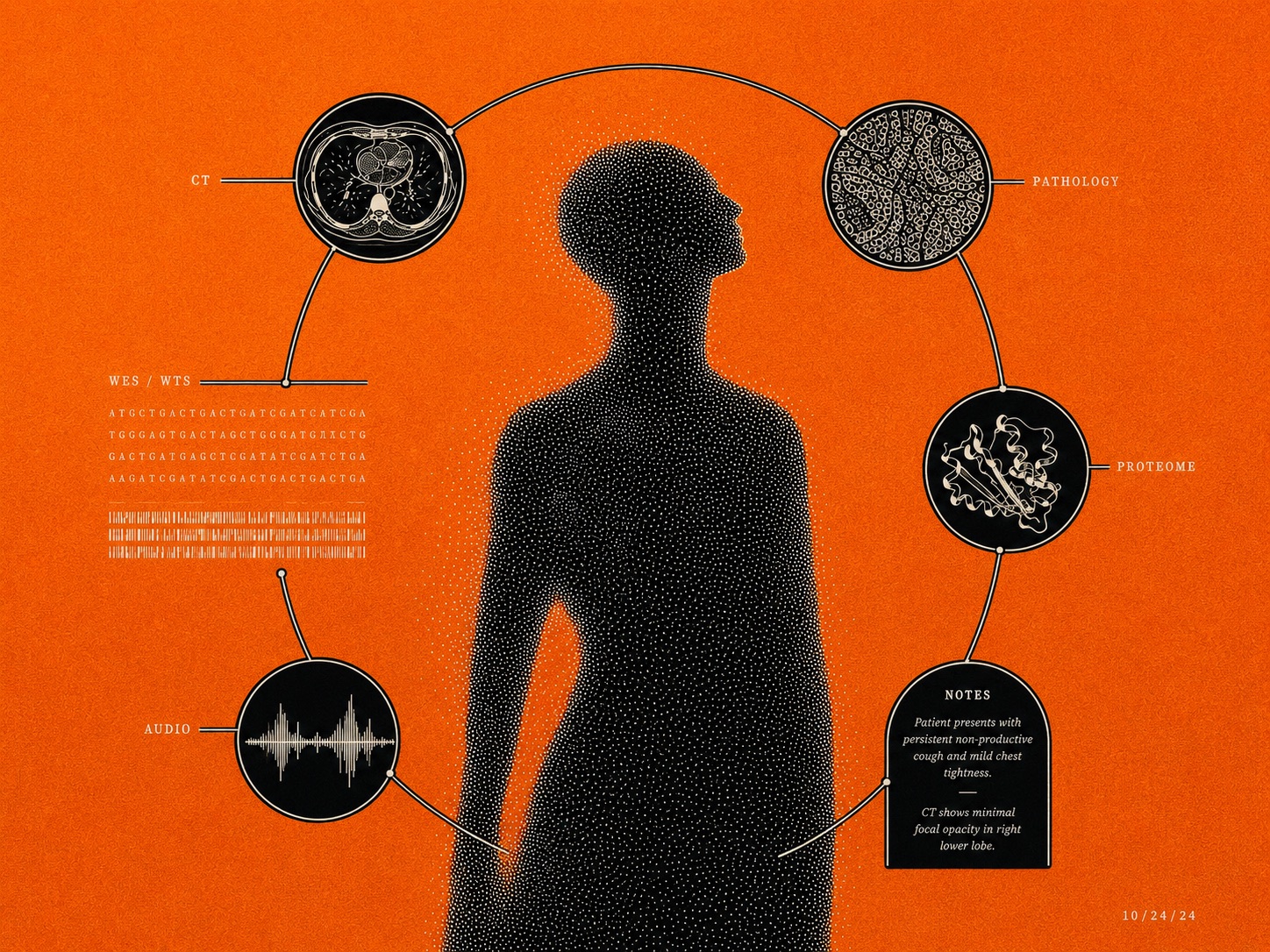
Continuum is Sarovi's longitudinal patient model: a way to keep clinical history, imaging, labs, omics, treatments, symptoms, research signals, and uncertainty connected over time.
Why Continuum
The patient should not reset at every appointment.
Healthcare is still episodic. The patient changes continuously, but the system often sees only snapshots: a visit, a scan, a lab panel, a PDF, a referral. Continuum is the infrastructure layer that preserves state between those moments.
We call it Continuum because the important object is not a cartoon copy of a person. It is the clinical continuity: what is known, what changed, what is uncertain, what is missing, and what might happen next.
What improved, worsened, stabilized, appeared, disappeared, or failed to get measured.
Risk, therapy response, monitoring needs, prevention opportunities, and counterfactual planning.
Every claim should point back to source data, model version, clinician edits, and confidence.
How it is built
A living model needs data contracts, not magic.
- 01Temporal spine
Visits, labs, imaging, medications, symptoms, interventions, and follow-up events are placed on one patient timeline.
- 02Multimodal features
Protocol contributes WES/WTS and biomarkers. SaroviX contributes notes, imaging, documents, voice, and clinical actions. Compute contributes derived analyses.
- 03Uncertainty and provenance
The model distinguishes measured evidence from inference, missing data from normal data, and clinician-approved facts from draft suggestions.
- 04Embeddings and cohorts
Patient context can be represented for similarity search, nearest-neighbor review, cohort comparison, and research hypothesis generation.
- 05Projection and feedback
Follow-up data updates the model, tests assumptions, and helps the system learn where earlier prediction was wrong or incomplete.
Where it helps
Continuity changes what a care team can ask.
Preventive medicineWhich patients are drifting toward risk before they become acute, and what follow-up would change the trajectory?
Complex chronic careWhat changed across labs, symptoms, medications, imaging, and molecular signals since the last real decision?
OncologyHow do imaging response, therapy exposure, molecular findings, adverse effects, and performance status move together?
AutoimmunityCan immune activity, symptoms, treatments, triggers, and RNA/blood signals be tracked as one disease process?
ResearchWhich patient trajectories resemble each other, and which mechanisms might explain outliers or treatment resistance?
Continuum is a model of state, evidence, and change. It avoids pretending that a patient can be reduced to a decorative avatar.
Clinical safety
A patient model must be useful, inspectable, and humble.
Continuum should support clinicians by making context easier to understand, not by hiding uncertainty under a score. The model must expose assumptions, missing data, source evidence, and clinician edits.
Model-derived statements must be linked to records, features, versions, and review state.
Continuum is an aid for reasoning and follow-up, not an autonomous diagnosis engine.
Consent, retention, residency, access, and research reuse should be represented in the system.
Make healthcare remember the person between visits.
Continuum is where Protocol, SaroviX, and Compute become longitudinal medical infrastructure.
Discuss Continuum ->